A LITTLE MORE SOCIAL is a new book by Nicholas
Epley (Mindwise) where he explains “How Small Choices Create Unexpected
Happiness, Health, and Connection.” Epley is the John
Templeton Keller Professor of Behavioral Science and faculty director of the
Roman Family Center for Decision Research at the University of Chicago Booth
School of Business. He argues that we should not allow fear and myths to keep
us from reaching out more to others, pointing out that if we work on changing
our often overly pessimistic expectations, introverts and extroverts alike can benefit.
Instead, Epley encourages readers to treat beliefs as “bets” or “guesses”
rather than certainty and he discusses the rejection theory videos of Jia Jiang who invited rejection with outlandish
requests in an attempt to overcome his own fear. Several other chapters of A
LITTLE MORE SOCIALdeal with choosing Thankfulness, Kindness,
and Honesty. Overall, Epley cites numerous experiments and research in an
effort to convince people to be a little more open and he tries to offer specifics,
but changing a mindset is difficult and it would help to have more recognition
that not everyone has his capacity to reach out. Notes, related commentary, and an Index comprise
roughly thirty percent of the text. The video below is Epley’s Ted Talk: “The
Simple Habit for a Happier Social Life” and conveys many of the ideas in his
new book:
David Brooks interviewed Nicholas Epley at a Family Action
Network session on May 21 and that video will be posted shortly on their website. A
favorite quote? They referred to the idea that “everyone you ever meet knows
something you don’t.” A motivator like that may encourage readers to modify
their own routines.
GENIUS AT SCALEby Linda A. Hill, Emily
Tedards, and Jason Wild is an in-depth, thoughtful look at “How Great Leaders
Drive Innovation.” The authors’ credentials are impressive: Hill is the Wallace
Brett Donham Professor of Business Administration at Harvard Business School
(HBS); Tedards is a graduate researcher in organizational behavior at HBS; and
Wild is he former Global Vice President of CEO Co-Innovation and Customer
Engagement at Microsoft. Together, they essentially use case studies and real-world examples to talk about Architects,
Bridgers, and Catalysts effecting change in their organizations. Some of the
companies and groups mentioned are P&G, Pfizer, Mastercard, Delta Airlines,
as well as food organizations in Africa and Italy and the Sampark Foundation which
promoted educational advancements in India.
GENIUS AT SCALE is very accessible, with differently sized
helpful headers, a conversational tone, and a focus on individuals and their
stories. Much of this necessitates a new way of thinking, like Mastercard’s
emphasis on a Framework to Grow, Diversify and Build in the “World Beyond
Cash” or P&G’s increasing recognition that “the product economy was
shifting to an experience economy.” The
authors note that “as much as leaders would like to plan their
way to innovation, their job as architects is to help their teams and
organizations act their way instead,” referencing a vivid descriptor
from previous research: “it's like shifting from leading an orchestra to a jazz
ensemble: while their sheet music provides some guardrails, the musicians have
to improvise, listen, and adapt to each other as they perform.” Another chapter looks at the establishment of
the Cleveland Clinic in Abu Dhabi, stressing the importance of continuous
learning and adapting to local practices, needing “to create an environment
where all caregivers could be ‘contemplative and creative rather than reactive
problem solvers’.” While reading, I found many insightful comments like when
the Sampark leadership opined “If you launch a decision as an initiative,
people wait for it to fail. If you launch it as an experiment -- indicating
that you will reverse it if it doesn't go right -- people participate in
shaping it. They own it.” The authors and those they studied repeatedly point
out how critical it is to have a “foundation of shared purposes and values -- a
sense of community." GENIUS AT SCALE is clearly extensively researched with notes
comprising at least ten percent of the book; there's also a helpful index and the
online bibliography contains a list of over 700 books and articles.Highly recommended.
THE OTHER SIDE OF CHANGE by Maya Shankar
is about “Who We Become When Life Makes Other Plans.” Shankar is a cognitive
scientist and neuroscience expert who describes the life altering changes faced
by guests on her podcast. She notes that the book is “part narrative, and part
practical guide, rooted in the latest scientific research.” Her first example (“Locked
In”) involves Olivia Lewis who becomes paralyzed; it is reminiscent (as Shankar
also notes) of events which impacted Jean-Dominique Bauby, author of Diving
Bell and the Butterfly, as well as of Allison Pataki’s Beauty in the Broken Places about her husband’s unexpected health scare. Shankar
notes how these individuals must confront what they have lost and then “experience
an internal transformation that allows them to imagine new and freeing
possibilities for themselves.” She also “shows how that sense of possibility
can ripple outward” and includes an Appendix titled “Getting to the other side
of Change: Your Change Survival Kit” where she summarizes key concepts (e.g., self-identity)
from each chapter. Her bibliographic notes and references comprise an
additional ten percent or so of the text. Shankar does an excellent job of
weaving examples and research, but this is based on numerous conversations,
sometimes covering years. I wonder how well a person in the midst of
devastating change would be able to comprehend, digest, and implement (without professional guidance) the ideas from this book. THE OTHER SIDE OF CHANGE received a
starred review from Booklist.
On a related note, I recently attended a conversation between Kelly Corrigan and Jennifer Breheny Wallace about Wallace's new book titled MATTERING. The event was sponsored by Family Action Network and a recording is available:
According to the publisher: Wallace argues that mattering—the feeling that we are valued and have the chance to add value—is a core human need, as essential to our well-being as food and water. ... MATTERING shows how lives are transformed when we are reminded, in small but intentional ways, that we are seen, valued, and needed. Wallace identifies the essential components of what she calls a “mattering core”: recognizing your impact, being relied on (but not too much), feeling prioritized, and being truly known and invested in. ... Wallace shows how to strengthen our own sense of mattering—and how to build cultures of mattering in our homes, workplaces, and communities—at a moment when it has never been more urgent.
WHY ARE WE HERE? by Jennifer Moss
(The Burnout Epidemic) is subtitled “Creating a Work Culture Everyone
Wants” and I recently viewed an hour presentation on this new book supplied by Harvard
Business Review Press. Clearly Moss’s work has wide appeal as attendees hailed
from around the world.Moss writes about
the increasing disengagement, detachment, and disillusionment amongst members
of the workforce, often citing both private (e.g., Gallup’s reports like one on
State of the Global Workplace) and government (e.g., the CDC on health risks
associated with lack of social connections) sources. Moss advocates for
improving culture by devoting twenty minutes per week, noting that people want
hope from their leaders and they need to see a future. Specifically, she
suggests numerous activities such as celebrating milestones more frequently or
telling more stories. Other ideas include “make the mundane meaningful,” save
space for exploration, and initiate “stay” interviews. All of that seems to reflect
offering respect for and listening to one’s workforce, which she approaches in
the last two chapters on Belonging and Recognition. Notes and index represent
about ten percent of this well-researched text. Moss admits “this was the
hardest book I’ve written yet.” I think it may be hard for readers, especially
leaders, to accept and internalize her many suggestions without guidance and some
kind of checkpoints. I look forward to her future work and additional case studies. Listed in the Next Big Idea Club's January 2025 Must-Read Books.
THE AGE OF GRIEVANCEby Frank Bruni is a new work of non-fiction which
covers politics and of which his publisher says, “there’s a potentially
devastating erosion of the civility, common ground, and compromise necessary
for our democracy to survive. How did we get here?” Bruni points to numerous
examples, some all the more relevant with the number of arrests in recent days on
college campuses. He does offer “The
Antidote,” as his final chapter is titled: there, he describes humility, humility
from political leaders, from journalists, from activists, and from ourselves. Unfortunately, his text seems rather biased,
condescending, even a bit whiny - all the things that he is urging readers to
avoid. For example, he writes, “Not all grievances are created equal. … There
is January 6, 2021, and there is everything else. Attempts by leaders on the
right to minimize what happened that day and lump it together with protests on
the left are as ludicrous as they are dangerous.” Despite the legitimacy of his
point, it does not seem consistent with attempts to foster dialogue and
toleration. Have a look and decide for yourself, but also spend some time with
texts like The
Sum of Us by Heather McGhee - a much more positive take on
how we can come together. Bruni himself also provides an excellent list of roughly three
dozen titles for “further reading.”
SUPERCOMMUNICATORSby Charles
Duhigg (The Power of Habit and Smarter, Faster,
Better); describes “How
to Unlock the Secret Language of Connection.” Duhigg, a Pulitzer Prize–winning investigative journalist and author,
writes that this book “is an attempt to explain why communication goes awry and
what we can do to make it better. At its core are a handful of key ideas.” He
continues by describing three kinds of conversations (practical or
decision-making; emotional; and social) which he says primarily addresses one
of three broad questions: What’s this really about? How do we feel? Who are we?
Duhigg stresses that we need be more skilled at determining which type of
conversation is occurring and then also in applying the different skills needed
for each. I found myself thinking about this recently when talking to a friend
and was able to ask a version of “Do you want me to help you solve this
problem, or just listen?” After several years of studying the topic, Duhigg believes
that anyone can become a super communicator and can have more meaningful
discussions or “learning conversations.” First step: ask yourself “Why am I
opening my mouth?” He acknowledges that this is very difficult and employs
real-life examples to illustrate several rules in a well-organized series of
guides. To gain a better overview, see an essay by Duhiggthat outlines
his thinking, particularly about listening, sharing, and connecting (recently
published in The Wall Street Journal). SUPERCOMMUNICATORS received a starred review from Publishers Weekly. Much advice worthy of reflection, perhaps in
conjunction with David Brooks’ How to Know a Person.
1000 WORDSby Jami Attenberg (Saint Mazie) is the result of an effort by Attenberg
and fellow writer Anne Gisleson to motivate themselves. She says that one
thousand words (about four type-written pages) is a workable daily goal for
her, but that each reader should decide individually on a goal. The text
continues by offering ideas on where to write, how to begin, and later reading
your work out loud, emphasizing that while writing can be isolating, one is not
alone in this creative work. She categorizes a creative life cycle as having
phases: internal and developmental; preparatory; committed; and a reflective
pause. In addition to the essays from Attenberg, there are inspiring contributions
from writers like Min Jin Lee, Roxanne Gay, Laila
Lalami, and Courtney Sullivan. This collection is subtitled “A Writer's Guide
to Staying Creative, Focused, and Productive All Year Round” and will likely
have the most appeal for those who are actively trying to write longer works. Aspiring
writers can also subscribe to Attenberg’s Craft Talk Newsletter. She notes, “You can create a sense of isolation in your mind. You can
tap into that hunger and desire to make something new. It's all sitting right
there. A pen, some paper, and your brain.” Described in numerous reviews as motivating,
comforting, and/or encouraging,1000 WORDSreceived a starred review from Booklist.
THE
PERFECT STORY by Karen Eber is another
excellent work which describes “How to Tell Stories that Inform, Influence, and
Inspire.” Eber begins by stating the storytelling is “an art that is grounded
in science” and she outlines several facets of stories: connection builders, change
agents, memorable, reinforcing values, and interactive. All of her chapters (e.g.,
Storytelling with Data) have a summary and a storytelling interview to
accompany them. This text is filled with vignettes which aptly illustrate the
power of storytelling and checklists to help with creation and implementation.
To learn more, see her TedTalk which has over two million views:
BOARD TALK is written by Kathryn
Bishop and Gillian Camm who believe that “conversation is at the heart of board
governance across the world.” They first offer six conversational techniques
(like observing, listening, and questioning) with a reflection on each. The heart of the book is the eighteen crucial
conversations centered around topics like joining a board, talking about vision/values,
and turning central ideas into action. They use models, checklists, and case
studies to help readers tap into ideas about how boards operate. According
to Bishop (a teacher at Oxford’s Saïd Business School) and Camm (an executive
coach) they have an overall goal to “help you reflect on the nature of your
board and your role in it, and to develop better conversations which will help
you to perform your role well.” Obviously, the authors speak directly to the
readers whom they assume are members of public, private, or voluntary boards around
the world. Their expertise in education and training is reflected in the text’s
use of bold font and bullet points, making it relatively easy for readers to
extract and reflect on key points. Published by Alison Jones’ Practical
Inspiration Publishing, below is an interview she conducted with the two
authors of BOARD TALK where they explore concepts
of psychology, mindset, and group governance:
BOARD TALK contains a list of useful information sources, notes, a bibliography,
and a thorough index, including a reference to Reclaiming Conversation by Sherry Turkle.
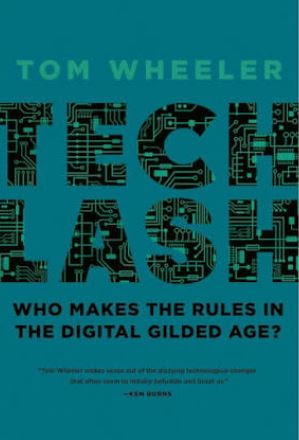
TECHLASH by Tom Wheeler poses the question: “Who Makes the Rules in the Digital
Gilded Age?” Wheeler, a businessman and former (2013-2017) Chairman of the
Federal Communication Commission (FCC), highlights parallels between the late
19th century’s industrial Gilded Age the digital Gilded Age of the 21st century:
increasing disparities in wealth and innovators making their own (self-interested)
rules. Saying “a shiny patina hides the darker realities,” Wheeler offers a
call to action. Consumer privacy certainly merits greater protection and a major
proposed task is rewriting rules and regulations although it is admittedly difficult
to picture current politicians having the will or means to do so. Wheeler observes
that “solutions that were developed in the past – antitrust law and regulatory
oversight– were unprecedented” at that time. He is extremely knowledgeable and devotes
an entire section of his new text to “Reasserting the Public Interest” where he
outlines proposals for establishing behavioral expectations for digital
platform companies with separate chapters dealing with privacy, competition and
“truth and trust.” Although the average
reader may find TECHLASH a bit too
complex, roughly fifteen percent of the text is devoted to notes and an index
which increases its usefulness for researchers and policymakers. They may also be interested in this recent McKinsey think piece on generative AI and government.