Showing posts with label future. Show all posts

Friday, May 8, 2026

How to Start by Jodi Kantor

HOW TO START by Jodi Kantor is subtitled “Discovering Your Life's Work” and is a slender (112 pages) text intended to offer informative reading for the 18- to 25-year-olds in your life. Kantor, a Pulitzer Prize winning investigative reporter for The New York Times, was asked to give the commencement speech at Columbia and that, in turn, inspired this text. She writes about developing craft (an often-slow accumulation of skill), identifying need, and the interplay between the two: “The craft she is learning will change and refine her assessment of that need. To meet that evolving vision, she will pursue higher forms of craft -- more skilled, new tools. Fresh needs will emerge, of the richness and strength of her craft will help her address the unexpected.” That may be a bit abstract for many 20-somethings, but they will likely benefit from Kantor’s acknowledgement of how universal their generation’s struggle is. HOW TO START is recommended by authors like Reid Hoffman (Superagency), Shonda Rimes (Year of Yes), and Gretchen Rubin (The Happiness Project) and this title also made me think of Tina Seelig’s What I Wish I Knew When I was 20 (she has a new book, What I Wish I Knew about Luck, forthcoming in June).

Jodi Kantor recently paired with Jennifer Breheny Wallace (Mattering) at a FAN session to discuss HOW TO START and the goals of financial stability, satisfaction (being connected to what one does), and contribution (how your career helps others). The recording will be available on the FAN (Family Action Network) website soon.

Sunday, April 5, 2026

The Infinite Sadness of Small Appliances by Dixon

THE INFINITE SADNESS OF SMALL APPLIANCES by Glenn Dixon is a relatively short (224 pages) but impactful tale that will make readers think, particularly about artificial intelligence and humankind’s relationships with machines. Set in the future, much of the story is told from the perspective of Scout, a young, but advanced model of a vacuum cleaner (like Roomba) who resides at the home of an older couple, Harold and Edie Winters. Scout is a curious and courageous soul (if machines can be said to have souls) who has chosen her name because of listening to Harold read To Kill a Mockingbird to Edie who has a terminal illness. As with any death, changes are necessary and painful. Scout appears to develop empathy for Harold, his daughter Kate, and the young neighbor boy, Adrian, who was a piano student of Edie’s. They all must learn to trust each other and the other sentient machines like Auto, Fridge, Clock and Watch. It is not easy to battle the overarching and controlling Grid which appears to have no feelings at all. Booklist sums it up well: “The plot is tender and suspenseful as Scout begins to grasp love, grief, and resistance.” Definitely Recommended. Book groups, too, would enjoy discussing THE INFINITE SADNESS OF SMALL APPLIANCES.

Sunday, September 15, 2024

The Mind's Mirror by Daniela Rus and Gregory Mone

THE MIND'S MIRROR by Daniela Rus and Gregory Mone (The Chip and the Heart) is another collaboration between a pioneering roboticist who is director of MIT's Computer Science and Artificial Intelligence Laboratory and a professional science writer. Their newest book focuses on “Risk and Reward in the Age of AI.” As ever, these two authors are extremely optimistic about the new technology and divide their text into three main sections: Powers, Fundamentals, and Stewardship. Taking a “hands-on” approach, they offer advice like: “as you evaluate how AI can help your business, I'd suggest breaking down the various roles within your organization by task, then looking at whether AI can assist, augment, or automate those tasks.”  The authors also point to the value of “business bilinguals, [those] who understand both tasks and technology” like understanding the complex issues involved with medical coding and AI application. About halfway through the text they offer a section which reads a bit like a business school case with “a detailed set of guidelines and questions to consider as you think about putting AI into action.” Later, they do turn to potential concerns and link to an effort to provide policy briefs on the governance of AI. They also devote considerable space to less commonly cited challenges in three spheres: technical (such as training data, complexity, security, reliability, bias), societal (like privacy, intellectual property, controls, overreliance, misinformation), and economic (impact on jobs, the rate of adoption, and so forth). THE MIND'S MIRROR is a relatively accessible text which could prompt numerous discussions, whether for student researchers or business applications. The two-part appendix provides a brief history of artificial intelligence plus an overview of the infrastructure of AI, followed by suggestions for further reading and a bibliography of sources.  

Wednesday, July 24, 2024

What's Next Is Now by Frederik Pferdt

WHAT'S NEXT IS NOW by Frederik Pferdt, Google’s first Chief Innovation Evangelist, describes “How to Live Future Ready.” Pferdt, who taught at Stanford for a decade, outlines five key points: make your future happen; your mindset is critical; learn to expect the unexpected; pursue better (progress, not perfection); and check in with yourself regularly (i.e, what future do I want to create?).  After briefly introducing about a dozen “future ready” people (mostly colleagues from Google), Pferdt stresses values like optimism, openness, curiosity, experimentation, and empathy and offers exercises to practice and develop those habits. His “work is entirely focused on the future -- how to see potential and solve challenges in situations we haven't yet encountered.” This is an inspirational text and might make more sense to read as a team, reinforcing each other and re-emphasizing the hard work of shifting mindsets so as to adhere to the “belief that change is constructive, not a threat.” What fun, for example, to explore and play together with Google’s Arts and Culture resources. WHAT'S NEXT IS NOW is a 2024 Next Big Idea Club selection.  Pferdt’s emphasis on “future ready” made me think about the ALA program with that title from a few years ago.

Thursday, September 7, 2023

The Coming Wave by Mustafa Suleyman

THE COMING WAVE by Mustafa Suleyman, subtitled “Technology, Power, and the Twenty-first Century's Greatest Dilemma,” is about the potential impact of advanced artificial intelligence (AI) and biotechnology. Suleyman, co-founder of DeepMind, illustrates the point beautifully in the prologue which notes, “we are faced with a choice – a choice between a future of unparalleled possibility and a future of unimaginable peril.” He argues for containment, admitting that it is extremely difficult, but necessary and suggests biomedical ethics and regulations as a possible model. He also encourages readers to look at “choke points” (e.g., chip production) as another means of control or restraint. Think about changes we have seen in the last few years: Suleyman says, “Today, AI systems can almost perfectly recognize faces and objects. We take speech-to-text transcription and instant language translation for granted. … AI has been climbing the ladder of cognitive abilities for decades, and it now looks set to reach human-level performance across a very wide range of tasks within the next three years.” That is a very specific prediction from an experienced and well-regarded expert. THE COMING WAVE is a disturbing read, but one which merits much discussion and has received praise from Daniel Kahneman (“essential reading”), Bill Gates (“an excellent guide”), and Eric Schmidt (“utterly unmissable”). More information is available through interviews on Axios and on Have a Nice Future from Wired magazine.

Saturday, July 17, 2021

Wasted by Byron Reese and Scott Hoffman

WASTED by Byron Reese and Scott Hoffman seeks to explore “How We Squander Time, Money, and Natural Resources-and What We Can Do About It.” Written by a couple of Austin-based entrepreneurs, WASTED is a wide-ranging look at our world and its problems. As the authors note, “one of the major themes of this book deals with what is seen and what is unseen. When we think of waste, it’s easy to picture all the food that’s thrown away.  It’s much harder to see the second – and third – order effects of trying to avoid waste in the first place.” Reese and Hoffman note the characteristics of waste in a broad manner (undesirable, incurs a net negative cost, and can be avoided). They then divide the text into four parts dealing with Waste and Our Planet (covering sub areas like plastics, aluminum cans, and water); Waste in our Business (e.g., returned goods and food waste); The Science of Waste (carbon footprints; electricity and fuel use); and The Philosophy of Waste (referring to time, money and even human potential). The multi-faceted text is bursting with facts (“there are 800 million hungry people in the world, and Americans and Europeans spend enough just on cosmetics to feed them all” or “the family dog has a bigger carbon footprint than the family SUV”) which will surprise and intrigue our student researchers. In addition, WASTED concludes with a rather hopeful discussion of how we, as a society, can achieve less waste and looks at the role of government, businesses, voluntary associations, institutional religion, public opinion and individual action. The index is over a dozen pages long, but I did not see any notes – of course, those would be helpful in pursuing more deeply the many points Reese and Hoffman raise.

Saturday, November 21, 2020

Leave the World Behind by Rumaan Alam

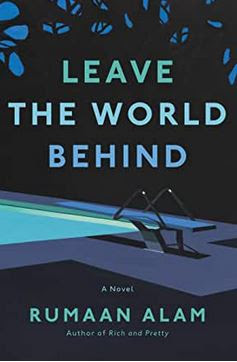
LEAVE THE WORLD BEHIND by Rumaan Alam shares an eerie story set in the near future when a family heads for vacation only to find that “something” has happened to disrupt communications networks.  While there are some obvious parallels to our current uncertain world, I found this rather ominous tale to be a well-written means of escape.  Alam’s novel was nominated for the National Book Award and called “a brilliant, suspenseful examination of race and class” by The Washington Post’s reviewer. And, yes, there are insightful comments: “his wife felt it important, not to do the moral thing necessarily, but to be the kind of person who would. Morality was vanity in the end.” And so, the vacationers (a White family) attempt to deal with disruption to the electric grid (“he had not realized how much light connoted safety, and how much dark its opposite”) when the when the owners (a Black couple) of the rental property seek refuge there. Apprehensive at first, they gradually come to rely on each other. The somewhat ambiguous ending merely reinforces Alam’s exhortation: “To enjoyment …. To the enjoyment of any moment in life, I guess. Enjoying any moment is a victory.  I think we need to hold on to those.” LEAVE THE WORLD BEHIND received starred reviews from Booklist, Kirkus, and Publishers Weekly.  


Tuesday, February 18, 2020

This Could Be Our Future by Yancey Strickler

THIS COULD BE OUR FUTURE by Yancey Strickler, co-founder and former CEO of Kickstarter, is intended to be “A Manifesto for a More Generous World.”  As such, Strickler discusses how we have come to value financial maximization and how the solution is not to get rid of money, but to expand our concept of value. He argues that “our potential for a more generous, moral, or fair society is limited by the dominance of money as the be-all and end-all.” I know that students (and teachers) would be intrigued by this book, particularly those who are increasingly alarmed by our environmental situation, as well as the corruption and inequality that they perceive to be a result of our self-interest and materialistic lifestyle. As the publisher says, this book “is about how we got here [Part One], and how we change course [Part Two]. That later section is particularly fascinating, beginning with a brief overview of Maslow’s hierarchy of needs and moving to an exploration of graphs of self-interest vs. time; a concept that Strickler refers to as Bentoism. He introduces several scenarios and looks at the values associated with quadrants corresponding to Now Me, Future Me, Now Us and Future Us. There is an appendix with suggested reading, a comprehensive set of notes, and a useful index. THIS COULD BE OUR FUTURE seems like a must read book with positive blurbs from thought leaders including Seth Godin, Adam Grant, Simon Sinek, and Daniel Pink.

Welcome to Continuing the Conversation!

We are in the midst of migrating book reviews to this new blog.  To see past reveiws and comments, please visit Book Talk ... A Conversation...