Showing posts sorted by relevance for query adam grant. Sort by date Show all posts
Showing posts sorted by relevance for query adam grant. Sort by date Show all posts
Saturday, December 9, 2023
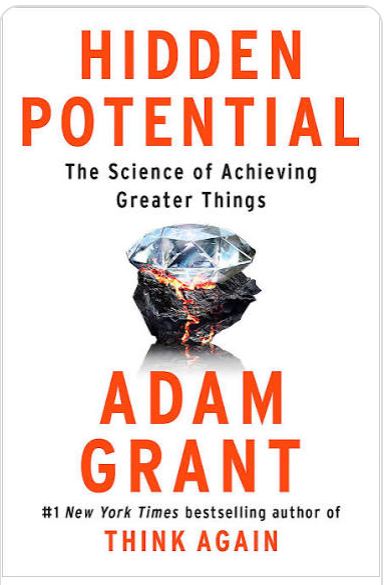
Hidden Potential by Adam Grant

Sunday, February 28, 2021
Think Again by Adam Grant

Monday, October 11, 2021
Working leads to Retirement Perspectives


Monday, March 18, 2024
The Breakthrough Years by Ellen Galinsky

THE BREAKTHROUGH YEARS is the latest parenting text from Ellen Galinsky, a well-respected researcher and prolific author who is currently President of Families and Work Institute. In this lengthy (560 pages) book, she presents “A New Scientific Framework for Raising Thriving Teens.” As she begins to outline the structure of her book, she highlights pleas from teens to address questions like: Why don’t adults understand us? and Why do adults have such negative views of teenagers? This echoes the sentiments expressed in the recently published Underestimated, although that text takes a decidedly less scientific tone. Galinsky notes five main messages which teens want to share: (1) Understand our development; (2) Listen and talk with us, not at us; (3) Don’t stereotype us; (4) We are trying to understand ourselves and our needs; and (5) We want to learn life and learning skills. Galinsky describes relevant research, including copious quotes from adolescents (ages nine to nineteen, per her definition). For example, she discusses emotional regulation, how adolescents learn to manage emotions, even the benefit of strong emotions, and then continues with a look at “the vital connection between rewards, motivation, and learning.” Perhaps the most helpful, though, are Galinsky’s thoughtful suggestions like those she offers for rethinking adolescence and seven reasons (e.g., protective instinct, fear, etc.) for why we experience difficulty in reframing negative attitudes towards teens.
For each of the five key messages listed above, she repeats a pattern of quotes from teens; reflection on the message (with comments from adults and parents); and then a detailed and segmented overview of relevant science and summary lists (e.g., four components of foundational executive function skills) and proposed actions. The text’s layout with multiple subheadings, italics and bold typeface aids the reader’s comprehension. Frankly, there is SO much here to digest and apply that Galinsky’s text could easily provide a valuable yearlong one book-one school read. Roughly twenty percent is devoted to notes and bibliographic citations; she also provides an amazing list of the dozens of researchers and thought leaders interviewed. THE BREAKTHROUGH YEARS received a starred review from Publishers Weekly (“Overflowing with insight backed by scientific rigor, this is an essential companion for parents of adolescents.”) and very positive comments from experts like Lisa Damour, Angela Duckworth, Kenneth Ginsburg, Adam Grant, and Daniel J. Siegel. PLEASE NOTE: Family Action Network is hosting a Zoom session with Ellen Galinsky on Tuesday, April 16th at 7:00 pm. Watch their website for details on how to register.
Added: Recording of the program (about an hour) is now available.
Tuesday, February 18, 2020
This Could Be Our Future by Yancey Strickler
 THIS
COULD BE OUR FUTURE by Yancey Strickler, co-founder and former CEO of
Kickstarter, is intended to be “A Manifesto for a More Generous World.” As such, Strickler discusses how we have come
to value financial maximization and how the solution is not to get rid of
money, but to expand our concept of value. He argues that “our potential for a
more generous, moral, or fair society is limited by the dominance of money as
the be-all and end-all.” I know that students (and teachers) would be intrigued
by this book, particularly those who are increasingly alarmed by our
environmental situation, as well as the corruption and inequality that they
perceive to be a result of our self-interest and materialistic lifestyle. As
the publisher says, this book “is about how we got here [Part One], and how we
change course [Part Two]. That later section is particularly fascinating,
beginning with a brief overview of Maslow’s hierarchy of needs and moving to an
exploration of graphs of self-interest vs. time; a concept that Strickler
refers to as Bentoism. He introduces several scenarios and looks at the values
associated with quadrants corresponding to Now Me, Future Me, Now Us and Future
Us. There is an appendix with suggested reading, a comprehensive set of notes,
and a useful index. THIS
COULD BE OUR FUTURE seems like a must read book with positive blurbs
from thought leaders including Seth Godin, Adam Grant, Simon Sinek, and Daniel
Pink.
THIS
COULD BE OUR FUTURE by Yancey Strickler, co-founder and former CEO of
Kickstarter, is intended to be “A Manifesto for a More Generous World.” As such, Strickler discusses how we have come
to value financial maximization and how the solution is not to get rid of
money, but to expand our concept of value. He argues that “our potential for a
more generous, moral, or fair society is limited by the dominance of money as
the be-all and end-all.” I know that students (and teachers) would be intrigued
by this book, particularly those who are increasingly alarmed by our
environmental situation, as well as the corruption and inequality that they
perceive to be a result of our self-interest and materialistic lifestyle. As
the publisher says, this book “is about how we got here [Part One], and how we
change course [Part Two]. That later section is particularly fascinating,
beginning with a brief overview of Maslow’s hierarchy of needs and moving to an
exploration of graphs of self-interest vs. time; a concept that Strickler
refers to as Bentoism. He introduces several scenarios and looks at the values
associated with quadrants corresponding to Now Me, Future Me, Now Us and Future
Us. There is an appendix with suggested reading, a comprehensive set of notes,
and a useful index. THIS
COULD BE OUR FUTURE seems like a must read book with positive blurbs
from thought leaders including Seth Godin, Adam Grant, Simon Sinek, and Daniel
Pink.
Thursday, June 4, 2026
Inside the Box by David Epstein

Monday, March 7, 2022
Robots and Artificial Intelligence


Saturday, May 31, 2025
Hello, Cruel World! by Melinda Wenner Moyer

Saturday, January 15, 2022
Get it Done by Ayelet Fishbach

Professor Fishbach will be speaking (via Zoom) on Tuesday,
January 18 at 7:00pm for an event sponsored by Family Action Network (FAN); I am looking forward to
that talk especially after seeing the number of positive comments regarding GET
IT DONE from authors like Adam Grant, Carol Dweck, and Angela
Duckworth.
Monday, May 31, 2021
Scout Mindset by Julia Galef

And, I have found a great video to visually reinforce this point with students – be ready to try the unconventional, just like Javy Baez running the bases for the Cubs:
Here is a quick summary of the contrast which Galef describes:

Additional positive reviews from Adam Grant (Think Again) and Daniel Kahneman (Noise – review forthcoming).
Subscribe to:
Posts (Atom)
-
 HEART OF A STRANGER by Angela Buchdahl is certainly in contention for my favorite book of the year. That is a surprise because this is the ...
 -
 MRS. ENDICOTT'S SPLENDID ADVENTURE is the latest historical fiction from Rhys Bowen ( In Farleigh Field ). She is a personal favorite a...
 -
 EAT YOUR ICE CREAM by Ezekiel J. Emanuel offers “Six Simple Rules for a Long and Healthy Life.” Emanuel, a bioethicist and professor at the...