Showing posts sorted by relevance for query mindset. Sort by date Show all posts

Monday, May 31, 2021

Scout Mindset by Julia Galef

THE SCOUT MINDSET by Julia Galef is one of my favorite books of the year. I am seriously considering using portions of this non-fiction text to reinforce key concepts when I teach research skills. Galef emphasizes the difference between a “soldier mindset” (follow the rules) and a “scout mindset” (be open to new ideas and ways of scanning the environment). Many times, our students are set on proving a pre-conceived thesis, rather than letting the research organically drive their conclusions. Discussing Galef’s points about the disadvantages of defending our beliefs against outside threats and ignoring contrary evidence could lead students to appreciate the (re)search aspect of looking for information as well as reward a willingness to experiment more fully with databases and credible web sites.  As Michael Shermer notes in his Wall Street Journal review of THE SCOUT MINDSET, “’I was wrong’ and ‘I changed my mind’ become virtues instead of vices.” I loved Galef’s tales of the scout mindset where “there’s no such thing as a ‘threat’ to your beliefs. If you find out you were wrong about something, great – you’ve improved your map and that can only help you.”

And, I have found a great video to visually reinforce this point with students – be ready to try the unconventional, just like Javy Baez running the bases for the Cubs:

Here is a quick summary of the contrast which Galef describes: 


Additional positive reviews from Adam Grant (Think Again) and Daniel Kahneman (Noise – review forthcoming).

Monday, August 8, 2022

The Innovation Mindset

THE INNOVATION MINDSET is written by Lorraine H. Marchand, general manager of life sciences at IBM Watson Health, with John Hanc. Marchand draws on her long experience in new product management and her work as an adjunct professor at Columbia Business School to develop and describe “Eight Essential Steps to Transform Any Industry.” These “laws” are explained in individual chapters filled with illustrative anecdotes, questions to consider and some summary takeaways. The many examples add a practical, realistic note and help make the ideas more memorable. Although THE INNOVATION MINDSET is slightly repetitive in places, it could provide an excellent outline and discussion prompt for Business classes as well as for individual entrepreneurs and corporate employees. Marchand acknowledges that she has written this text for readers “interested in fomenting change or who want to better understand the process of innovation.” And she is an superb guide, helpfully including a chapter devoted to the “unique challenges women innovators face and why” plus an appendix which lists resources for women innovators. That is only one of seven appendices; others include information about and examples of a business plan, funding application, and a pitch deck. Be curious and have a look at THE INNOVATION MINDSET – as Marchand writes, “whether you are sixteen or sixty, your whole life is ahead of you. You can choose your area of focus and start generating new ideas today. Your time is now.”   

Friday, March 25, 2022

The Expectation Effect by David Robson

I have written extensively about books and research that deal with one’s mindset, thinking, and mindfulness so I turned eagerly to THE EXPECTATION EFFECT by David Robson, an award-winning science writer who has previously worked as an editor at New Scientist and a senior journalist at the BBC. Immediately, I saw several chapters that would be of interest to our students: taking the pain out of exercise; healthy eating; de-stressing; building will power and creativity. Robson argues that “beliefs can become self-fulfilling prophesies, changing our lives for better or worse” and that learning to reset expectations “can have truly remarkable effects on our health, happiness, and productivity.” Employing a conversational tone, Robson acts as a coach and encourages his readers by weaving his personal experiences with scientific research, often published in peer-reviewed journals (my preview copy had close to five hundred footnotes). He simplifies explanations and offers memorable examples (like the hotel cleaners’ experience of increased fitness or students who exhibited improved academic performance when instructed to reframe their situations). The quote Robson chooses from Alia Crum at Stanford provides an overview: “Our minds aren’t passive observers simply perceiving reality as it is; our minds actually change reality. In other words, the reality we will experience tomorrow is in part a product of the mind-sets we hold today.” THE EXPECTATION EFFECT is worth reading in more detail; pick up this book and learn much more about “How Your Mindset Can Change Your World.”

Tuesday, August 27, 2024

10 to 25 by David Yeager

10 TO 25 by David Yeager is subtitled “The Science of Motivating Young People” and is self-described as “A Groundbreaking Approach to Leading the Next Generation—And Making Your Own Life Easier.” I am honestly not sure how “groundbreaking” this text is, although it seems likely to make relationships easier as Yeager stresses the responsibility of involved adults to adjust their own mindset, setting high standards while intentionally becoming more aware of young people’s need for respect. Building on case studies and interviews with successful mentors, 10 TO 25 offers an important perspective and provides numerous helpful suggestions for working with the next generation. Yeager is a professor of psychology at the University of Texas at Austin and has conducted research with Carol Dweck (Mindset), Angela Duckworth (Grit), and Gregory Walton (Ordinary Magic, forthcoming). His dozen chapters deal with taking action related to traits like Transparency, Questioning, and Belonging. The final section, called Putting It into Practice, includes specific “activities and pieces of advice” related to key ideas. Encouraging readers to keep a journal as they work through the exercises, Yeager notes that he uses these interventions in his own work and co-developed them with Rosalind Wiseman (author of Queen Bees and Wannabes). That section is an excellent summary and guide; it is followed by an extensive (roughly twenty percent of the book) series of notes and references. Booklist calls 10 TO 25 a “goldmine…” We have ordered this title and know it will receive much interest, especially at this high energy time of year as schools are opening.

Saturday, December 31, 2022

Stress and Anxiety in the New Year

THE STRESS PRESCRIPTION (Seven Days to More Joy and Ease) by Elissa Epel (co-author of The Telomere Effect) is part of a series; other titles, also written by experts in their respective fields, include The Love Prescription and The Sleep Prescription. Epel is the director of UCSF’s Aging, Metabolism, and Emotion Center and serves on scientific advisory committees for the National Institutes of Health and the Mind & Life Institute. In this primer, she encourages readers to “read a chapter a day or a chapter a week” and offers one new skill (e.g., Embracing Uncertainty and Openness) per chapter. Epel provides a great deal of reassurance and plenty of personal examples, but not as much practical advice as I had envisioned. To me, there was simply too much emphasis on her own stories (e.g., running out of pipettes due to supply chain issues) and less on helping readers to really adopt some lifestyle practices. A positive element is that her suggested activities “need no special equipment, and at most take five to ten minutes.”  That short timeframe may make her recommendations attractive and “do-able” for readers.  Almost twenty percent of the book is devoted to a listing of further reading and resources and extensive notes.
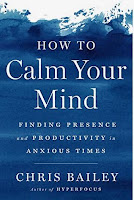
HOW TO CALM YOUR MIND by Chris Bailey is about “Finding Presence and Productivity in Anxious Times” and is also published by Penguin Life. Like in his earlier work, Hyperfocus, Bailey offers suggestions primarily for adult professionals. He notes, for example, “When you see everything you do through the lens of the accomplishment mindset, everything in your life looks like something you have to get done. In this way, an accomplishment mindset compromises how much joy you experience each day, as you alternate between periods of productivity, as well as guilt.” Bailey acknowledges investing in self-care through activities like meditation, exercise, getting a massage, and/or adopting a better diet, but he advocates doing more to reduce chronic stress, burnout, and anxiety. Bailey uses personal experiences to illustrate his points; plus, over ten percent of the book lists notes, including references for numerous scientific papers, which support his contentions. 

Concerns about stress and anxiety apply especially to young people; on a related note, see the article in today's Wall Street Journal from the Weekend Interview about "Jonathan Haidt on the ‘National Crisis’ of Gen Z." It is a sobering piece. 

Welcome to Continuing the Conversation!

We are in the midst of migrating book reviews to this new blog.  To see past reveiws and comments, please visit Book Talk ... A Conversation...