Tuesday, June 18, 2024
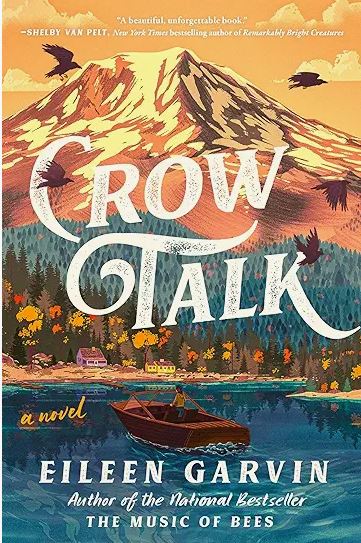
Crow Talk by Eileen Garvin

Wednesday, June 12, 2024
Stay Dead by April Henry

I have commented over the years on suspenseful young adult reads by April Henry like Eyes of the Forest or The Girl I Used to Be and STAY DEAD is another gripping mystery from this prolific, talented author. Sixteen-year-old Milan (great name, right?) has just been expelled from her third boarding school after the death of her Dad, Senator and environmentalist, Jack Mayhew. She and her Mom, Heather, who is now the serving Senator, are with staff aboard a private plane when it crashes. As the only survivor, Milan must rely on quick thinking and her past hiking experiences to beat the cold, the snow, and an animal predator as she struggles to get to Portland, Oregon and the only person her Mom told her to trust. That hazardous journey is exciting enough, but Henry treats readers to added perspective from Lenny, the woman hired to kill Milan and her parents, plus details from Jane, a dairy farmer dealing with the consequences of allowing fracking to occur on her farmland. The pace is quick – and Milan needs to draw on inner resources, remembering a favorite quote of her Mom’s from Amelia Earhart: “The most difficult thing is the decision to act. The rest is merely tenacity.” In her acknowledgments, Henry sounds super curious and adventuresome herself; she says, “as a writer, I've done many things for research, but probably the most intense was a three-day course called Urban Escape and Evasion. The final day of class you are kidnapped; hooded, cuffed, and mouth duct-taped.… You must use all your newly learned skills to escape...” Wow – that is serious research! And her adrenaline-charged writing reflects it. Enjoy!
Also wanted to note this quote... from another character who reflects on his departed wife: “She just got to heaven a little sooner than me, … she always liked to be early to things.”
Tuesday, June 11, 2024
The Skill Code by Beane & Code Dependent by Murgia
I am looking forward to virtually attending The Washington Post Futurist Summit on AI later this week. Here are another couple of new books related to that subject:

THE SKILL CODE by Matt Beane
is subtitled “How to Save Human Ability in an Age of Intelligent Machines” and
it looks at the importance of what Beane calls the expert-novice bond, meaning
that that we each achieved mastery by working with someone who knew more than we
did. Beane conducts extensive
observational field research as an ethnographer and in his role as an Assistant
Professor in the Technology Management Department at the University of
California, Santa Barbara. The first key insight he notes is “that the working
relationship between experts and novices is a bundle of three C's that humans
need to develop mastery: challenge, complexity, and connection.” He explains
those and points to threats to each, arguing “if we don't put this knowledge [3C’s]
to use right now, our species is in deep trouble.” Overall, this is really a
text about training, teaching and educational psychology. He points to how we
need to consciously make these new technologies part of the solution but not by
inserting them between novices and experts. A captivating section is where he
discusses “shadow learners” – people who take risks and step outside norms to
embrace the 3 C’s. Beane writes about finding challenge (not unlike Vygotsky’s
zone of proximal development (ZPD)) and provides a checklist to know when you
are facing healthy challenge. Beane then repeats those steps with respect to
complexity and connection, stressing the importance of “building mutual respect
and trust so that employees view a boss as an expert but also someone who cares.”
Like much of the rest of the book, this
is solid advice on social emotional skills and applies to any industry, whether
AI is involved or not. Added (9/8/24): The Wall Street Journal review: "Digital transformation has made the workplace more efficient. It has also reduced opportunities for skill development and mentorship."

CODE DEPENDENT by Madhumita Murgia is subtitled “Living in the Shadow of AI” and in a rather angry manner Murgia stresses the need for individuals around the world to unite in the face of AI. She writes about the concept of data colonialism and points to how gig workers (e.g., those affiliated with Uber) are oppressed and manipulated by algorithms. That made me wonder about how did business management transform from a cooperative, albeit paternalistic, view to an all-knowing heartless controller? Is that accurate? Is it part of a continual cycle of exploitation and reform? Some of these points were raised several years ago in The End of Loyalty by Rick Wartzman. Murgia, an award-winning Indian-British journalist who is currently AI Editor at the Financial Times, argues that “by reflecting on the march of AI, we can start to address the imbalances in power, and move towards redress.” Her work draws on examples from around the world, having spoken to people living in Kenya, Britain, Argentina, Italy, and to refugees from Iraq and China. In sections labeled Your Livelihood, Your Body and Your Identity, she shares concerns about wage differentials, deepfakes, and facial recognition. A subsequent section on Your Health features a doctor in rural India who is able to use an app to help to quickly diagnosis TB and later to contribute to recalibrate it to distinguish between TB and COVID. After several other chapters, Murgia describes OpenAI and Chat GPT and the tendency to hallucinate based on training. A favorite part is the Epilogue where Murgia describes the work of the world’s major religions in contributing to developing some ethical standards for deploying AI. Endnotes and an Index comprise between ten and fifteen percent of the text. The Guardian called CODE DEPENDENT “highly readable and deeply important,” saying “the power of this book lies in the rich stories it tells of individuals ... Drawing on interviews from around the globe.” Those stories veer between deep pessimism and glimmers of optimism and offer unique perspective. Much to consider.
Added from NPR: Pope to discuss AI at G7 meeting.
Monday, June 10, 2024
You Are Here by David Nicholls

Sunday, June 9, 2024
The AI-Savvy Leader by David De Cremer

Friday, June 7, 2024
Playing from the Rough by Jimmie James

Thursday, June 6, 2024
How the World Ran Out of Everything by Goodman

Subscribe to:
Posts (Atom)
-
 HEART OF A STRANGER by Angela Buchdahl is certainly in contention for my favorite book of the year. That is a surprise because this is the ...
 -
 MRS. ENDICOTT'S SPLENDID ADVENTURE is the latest historical fiction from Rhys Bowen ( In Farleigh Field ). She is a personal favorite a...
 -
 EAT YOUR ICE CREAM by Ezekiel J. Emanuel offers “Six Simple Rules for a Long and Healthy Life.” Emanuel, a bioethicist and professor at the...