Friday, March 28, 2025

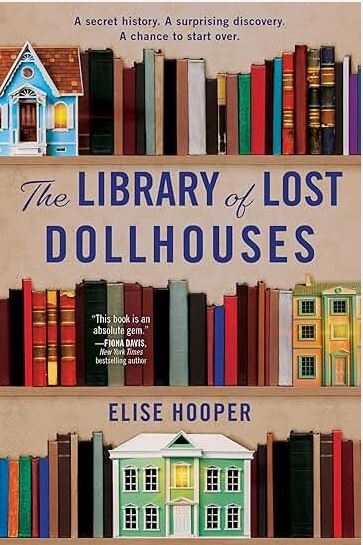
The Library of Lost Dollhouses by Elise Hooper

THE LIBRARY OF LOST DOLLHOUSES by Elise Hooper shares the stories of Tildy, a young librarian living in present day San Francisco, and Cora, a talented artist who lived in the early twentieth century. Their connection is the Belva Curtis LeFarge Library where Tildy discovers two long hidden dollhouses. As the alternating stories enfold, readers learn about Cora’s early life, travels in Europe, love affairs with both men and women, and her time during and after World War I when she began creating the miniatures. Although the story is sometimes a bit too slow-paced, Hooper certainly motivates her readers to reflect on the contributions of little recognized female artists (for a novel with a similar theme, see Clara and Mr. Tiffany by Vreeland). For me, the best part of Hooper’s book was the description of the intricate, detailed work on the dollhouses and their contents. Both the Thorne Rooms (on display in Chicago) and Queen Mary’s Dolls’ House (near London) are mentioned in the book and Hooper explains that “there's actually a psychological rationale to explain our affinity for small things: dollhouses offer us a sense of control and imagination. They can provide a feeling of agency. Miniatures allow us to create the world as we'd like to see it.” The audiobook is narrated by Emily Rankin and Caroline Hewitt who provide a clear and entertaining account of Cora’s and Tildy’s adventures. THE LIBRARY OF LOST DOLLHOUSES is a bonus fiction pick for LibraryReads in April 2025. Booklist recommends it for fans of Kate Morton and Fiona Davis.

Thursday, March 27, 2025

Three Minutes for Mom and Growing Together

It is Mothering Sunday in the UK this weekend and our own Mother’s Day (May 11) is fast approaching so I thought I would comment on a couple of newly published books having to do with parenting. THREE MINUTES FOR MOM by Erin Morrison showcases “365 Days of Empowerment, Encouragement, and Growth for a More Connected Motherhood.” Morrison has a background in psychological counseling and is the creator of The Conscious Mom. In this new text she encourages readers to actively “make three minutes of your day centered in strengthening, loving, and supporting you.” The entry for each numbered day offers a short saying (e.g., It’s Ok to Not Know OR Prepared, Not Perfect), a brief explanation which is a paragraph or two in length, and a quick recap (e.g., “when you run into a parenting moment that feels less than perfect, pause and ask yourself which prepared mother quality will help you best in this situation: open mindedness, compassion, or humility?”). Morrison is correct in that it may only take three minutes a day to read and reflect on an entry, but that regular activity may also help parents to pause and redirect their own energy. Whether it is day five (“add a little magic – if you don’t show your child that life can be magical, who will?”), day six (“the ‘why’ behind whining”) or day one hundred and ninety-three (“love and care for yourself”), Morrison’s writing is very supportive.  She provides an opportunity for quiet reflection and practical results.

GROWING TOGETHER by Carson Meyer contains “Doula Wisdom & Holistic Practices for Pregnancy, Birth & Early Motherhood.”  Meyer is a Los Angeles based childbirth educator and photographer who has created this text in order to share material from her online and virtual classes.  She splits the text into four primary sections, one for each trimester of pregnancy and then one for the first 100 days after birth. Her tone is quite conversational and she offers homeopathic remedies and common sense advice to numerous questions (e.g., How long should each feed be? Do I need to switch breasts each feed? Help! My breasts hurt!). Meyer includes weekly activities such as writing “a love letter to yourself” at week three after birth to help with “treating yourself with the same compassion and patience you would [for] your baby.” While new parents might be too overwhelmed to reach for this text, having read earlier sections might cause them to continue to seek out Meyer’s calm advice (“have a code word with your partner so that you can politely send away any visitor who is overstaying their welcome” or her discussion of elimination communication with their baby). Throughout, she provides charts (e.g., innate knowing vs. modern knowing), introspective questions, and frank discussion (e.g., “those first trimester feels” or “tending to the family nervous system”). GROWING TOGETHER contains recipes, endnotes, and a list of additional resources.

Saturday, March 22, 2025

Banned Together compiled by Ashley Hope Pérez

It’s not often that one sees a title with starred reviews from Booklist, Kirkus, Publishers Weekly and School Library Journal, but a new book intended for high school students achieved just that. Dedicated to “brave readers everywhere who persist when cowards try to erase stories and communities from libraries,” BANNED TOGETHER is edited by Ashley Hope Pérez and illustrated by Debbie Fong. In order to chronicle “Our Fight for Readers' Rights,” Pérez has compiled contributions (essays, poetry, drawings) from sixteen authors like Ellen Hopkins, Kyle Lukoff, and Nikki Grimes whose work has been challenged or banned. Also included is a short graphic novel type story about The Vandegrift Banned Book Club in Leander, Texas. Booklist says, “this collection movingly reminds readers of the power they have against censorship.” Check out a copy today. 

Another tool for restricting information is to limit library funding as evidenced in a recent executive order intent on dismantling "the only federal agency dedicated to sustaining the entire museum and library ecosystem in the United States." Please see the American Libraries Association page of FAQs about the recent executive order impacting IMLS, The Institute of Museum and Library Services. The ALA suggests several actions to take now. More information is available through news stories such as those found at The Conversation, the Associated Press, and NPR or from other advocacy groups like EveryLibrary.

Friday, March 21, 2025

Revenge of the Tipping Point by Gladwell

REVENGE OF THE TIPPING POINT by Malcolm Gladwell discusses “Overstories, Superspreaders, and the Rise of Social Engineering” twenty-five years after The Tipping Point was published. Gladwell writes that he re-immersed himself in “the world of social epidemics” and discovered a “new set of theories, stories, and arguments about the strange pathways that ideas and behavior follow through our world.” In terms of newer content, he focuses in part on "overstories" – the idea, like the upper portion or canopy in a forest, of a big picture perspective to better discern patterns and behavior changes. He also makes numerous references to the COVID pandemic and the notion of superspreaders. Throughout, he shares a variety of stories and circumstances from South Florida (where he says Miami is “ground zero for this extraordinary epidemic of [Medicare] criminality”) to the Harvard women’s rugby team (when he argues about how colleges use sports to manipulate group proportions) to frequent references to the opioid epidemic and the Sackler family. Gladwell incorporates charts, graphs and data as well as devoting more than ten percent of the book to endnotes and an index. REVENGE OF THE TIPPING POINT received a starred review from Kirkus. Interested readers may also want to turn to titles by the Heath brothers like Switch, Decisive, 2017’s The Power of Moments or 2022’s Making Numbers Count.

Thursday, March 20, 2025

Seven Social Movements that Changed America

SEVEN SOCIAL MOVEMENTS THAT CHANGED AMERICA by Linda Gordon is a penetrating look at events and happenings during the twentieth century. Gordon, an author and historian who has won numerous prizes for her biography of Dorthea Lange, reflects on several movements that still reverberate today. For example, one is the early work on old age pensions, eventually included in the Social Security Act of 1935, and highlighting the elderly as an activist political force. Other chapters discuss the efforts to unionize farm workers, promote civil rights in the 1950s and 1960s, and the subsequent women’s liberation movement. A more distressing example is the influence of the Ku Klux Klan (developed even further in Gordon’s 2017 text The Second Coming of the KKK) – and echoed, sadly, in the “very fine people on both sides” comments about the white nationalists protesting in Charlottesville. Gordon writes, “I am telling these stories [the seven social movements] in a way designed to reveal their commonalities as well as their distinctiveness.” Her tone is rather academic, and she argues that “‘followers’ often exerted vital but less often-recognized leadership.” Whether she is exploring early settlement houses and the fight against poverty, or efforts to establish job programs in the 1930s, her text offers researchers and scholars a thoughtful analysis and many details of value. At least a fourth of the book lists references and footnotes.

Wednesday, March 19, 2025

Kills Well with Others by Deanna Raybourn


KILLS WELL WITH OTHERS
by Deanna Raybourn features the same feisty, older female assassins as her Killers of a Certain Age. However, there seems to be a lot more killing and less humor in this sequel. The four women are asked in an unofficial capacity to take out a nefarious killer whose actions are linked to a long ago murder they committed. Raybourn does an excellent job of developing both that backstory and present-day adventures, but the assassins seem less appealing in this outing. A LibraryReads Hall of Fame selection for March, this novel is darker than expected, both in my view and that of other book group members who recommended Raybourn’s Veronica Speedwell series instead. I look forward to investigating those titles. 

Tuesday, March 18, 2025

Resist by Rita Omokha

RESIST by Rita Omokha is subtitled “How a Century of Young Black Activists Shaped America.” The author is an award-winning Nigerian American journalist and an adjunct professor at Columbia University’s Graduate School of Journalism. In RESIST she traces people and events from the 1920s (time of Scottsboro Nine) through the Civil Rights Era (Brown v. Board and education) to protests over Trayvon Martin and George Floyd and beyond. In late 2020 Omokha traveled over 13,000 miles (thirty states in thirty-two days); she spoke with 127 people and several of their stories are included. Omokha calls herself a storyteller ("drawn to the unsung. To the disenfranchised. To those often relegated to the shadows.") and says it is "important for me to make history personal." Her eloquent writing is filled with emotion: “Today's youth have become a generation forced to witness, from infancy, the perpetuation of injustice and the normalization of othering and subjugation. But in recent years, when such injustices occur, these atrocities pop up on their screens nonstop.” I learned much from Omokha’s book and the social justice efforts of people like Ella Baker, the Bates Seven at NYU, and defenders of the Jena Six, students at a Louisiana high school. Plus, she highlights numerous new – to me – details about other, more famous, activists or events (e.g., Obama’s 1981 speech against apartheid in South Africa). Omokha has included extensive notes and a helpful index. RESIST received a starred review from Booklist (“both incredibly detailed and accessibly readable … an essential text”).

Welcome to Continuing the Conversation!

We are in the midst of migrating book reviews to this new blog.  To see past reveiws and comments, please visit Book Talk ... A Conversation...